A cathodic protection reading is hard to review on its own. A useful CP inspection record ties each value to the test point, survey context, reference electrode, collection time, source, and the evidence that supports the next decision.
The examples below come from a synthetic, read-only product demo. CP-2038 / TS-09 is labelled “Within operator review band”; CP-2041 / TS-14 is labelled “Engineering review required.” Those are configured workflow states in this example, not universal thresholds, a compliance finding, or an engineering recommendation.
Two cathodic protection inspection examples
| Record detail | CP-2038 · TS-09 | CP-2041 · TS-14 |
|---|---|---|
| Operator review state | Within operator review band | Engineering review required; on hold |
| Pipe-to-soil on | -1,018 mV | -912 mV |
| Pipe-to-soil instant-off | -906 mV | -784 mV |
| Rectifier | 19.1 V / 7.5 A | 18.6 V / 7.2 A |
| Reference electrode | Cu/CuSO₄ · RE-4387 | Cu/CuSO₄ · RE-4421 |
| Location source | Field-device GPS import; 3.7 m reported accuracy | Field-device GPS import; 4.8 m reported accuracy |
| Evidence in the example | Normal-condition inspection image | Exception photo and source survey CSV |
The values make the records concrete; they are not an invitation to compare them against a generic pass/fail number. CP methods and interpretation depend on the survey type, asset, procedure, and qualified review. Use the applicable approved procedure to determine what the measurements mean.
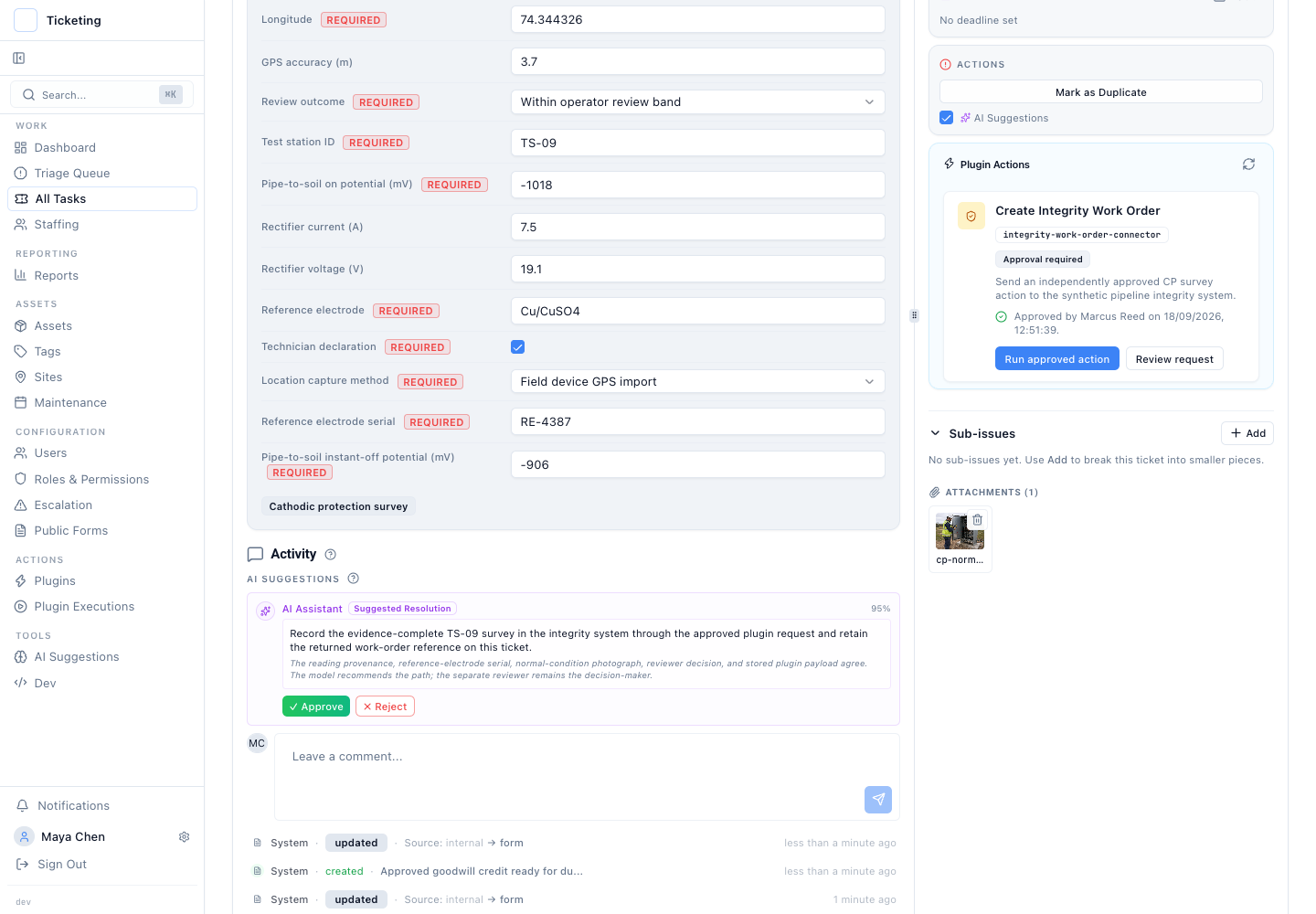
The TS-09 screen shows the recorded values and operator review state alongside the approved action. The displayed workflow state does not establish regulatory compliance.
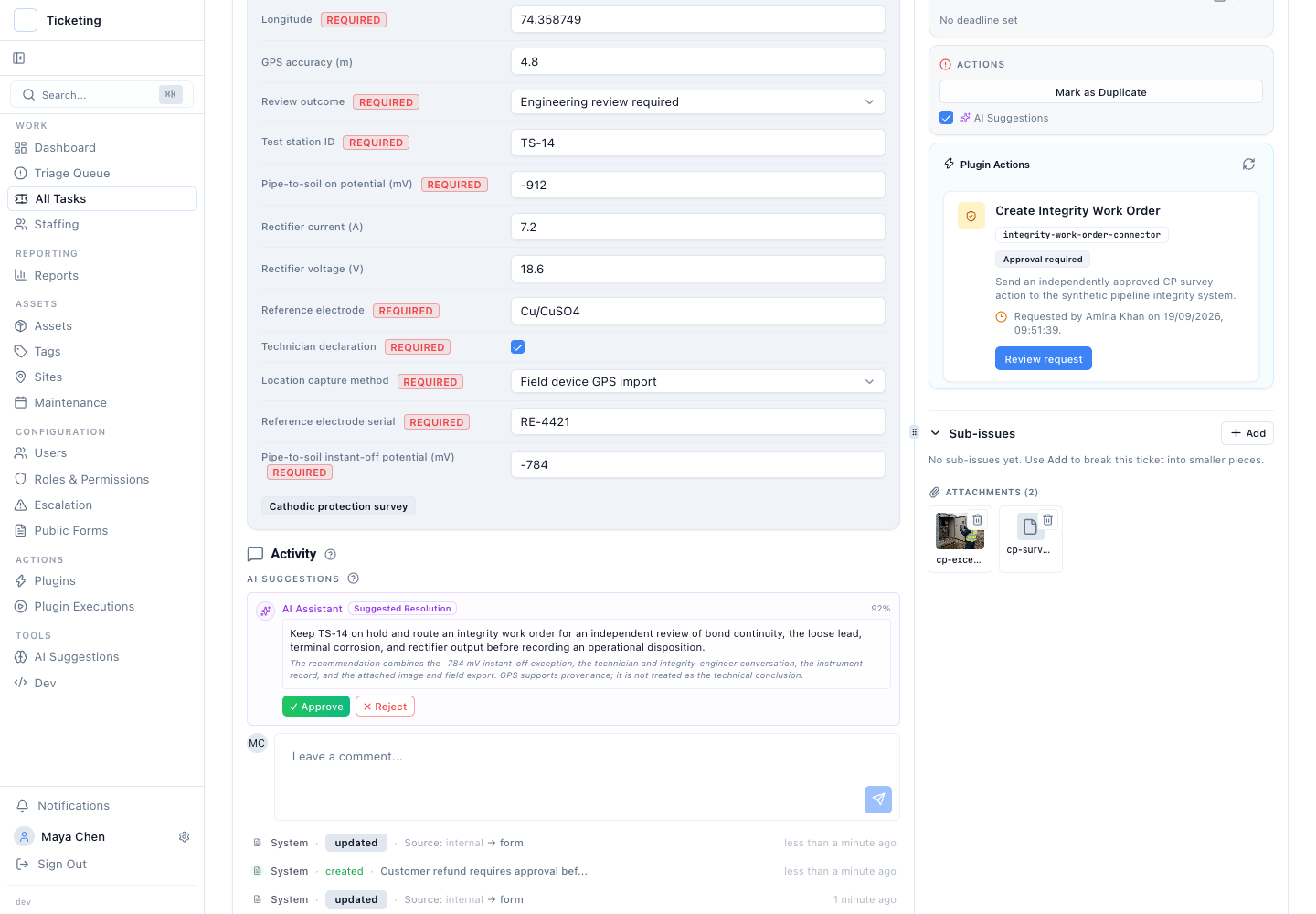
The TS-14 example remains on hold while a reviewer considers the evidence and proposed scope.
What makes a CP inspection record reviewable?
Identify what was measured. Include a survey ID, test-station or rectifier identifier, survey type, CP system, and asset reference. “Close interval on/off” and “rectifier inspection” are different survey contexts; a label should help the reviewer understand which record they are reading.
Keep measurement context with the values. Store units with pipe-to-soil on and instant-off potentials. Add rectifier voltage and current when relevant. Record the reference electrode type and serial, instrument or source reference, technician, and measurement time. Distinguish a missing reading from zero.
Preserve provenance and source evidence. Record how location was obtained and retain the original field export, notes, and photographs with the survey. Coordinates and their reported accuracy can help locate a record, but location does not validate a measurement. Keep the field collection time separate from a later upload time.
Write down the review state and next step. Explain whether the record is awaiting more evidence, needs an engineering review, or is ready for a scoped action under the team's procedure. A status such as “Engineering review required” communicates workflow; it is not itself the technical conclusion.
The synthetic TS-14 conversation shows why narrative context matters: the reviewer keeps the ticket on hold and asks for bond continuity, lead termination, and rectifier output to be checked before anyone records an engineering disposition. The technician records that no adjustment was made and preserves the original CSV for comparison. That sequence keeps observation, review, and action distinct.
From inspection evidence to a traceable handoff
On TS-09, the example shows an independent reviewer approving a stored request and a synthetic integrity-system response returning work-order reference IWO-88421. On TS-14, the proposed request asks for bonds, connections, and rectifier output to be inspected; its approval is still pending. The demo does not show a TS-14 work order being created.
These records illustrate why approval, execution, and field completion should be represented as separate events. A proposed action is not an approved action, an approval is not proof of execution, and a returned work-order reference is not proof that corrective work is complete.
For a field-by-field form design, use the cathodic protection inspection form checklist. To follow the exception through review and the proposed handoff, open the synthetic CP survey walkthrough. The cathodic protection survey workflow explains where a specialist field tool fits, and the inspection audit trail guide covers the wider evidence-to-action pattern.